

Marcus Johansson is a senior executive at Xcel Energy leading wildfire mitigation, digital transformation and grid modernization. He drives AI-enabled innovation, strategic investment and application rationalization efforts, delivering measurable value and operational resilience across the grid. Marcus is known for building high-impact partnerships and championing data-driven utility transformation.
As utilities face unprecedented challenges from climate change, aging infrastructure, and rising customer expectations, the urgency to modernize the electric grid has never been greater. At Xcel Energy, our commitment to safety, reliability, and sustainability is driving a bold transformation grounded in data, innovation, and resilience.
Building Intelligence into Wildfire Mitigation Efforts
Central to our wildfire mitigation efforts is the integration of artificial intelligence and advanced analytics. By deploying data lakehouse tools such as Databricks, we’re building AI-powered solutions that help us proactively identify, assess, and mitigate wildfire risk across our service territories. These tools enable us to analyze a complex interplay of weather patterns, grid load, vegetation exposure, and structural vulnerabilities using both probabilistic and deterministic modeling techniques.
“Ultimately, our work is more than mitigating wildfires. It’s about building a smarter, safer, and more responsive energy future”
Collaboration is essential to this mission. Every day, we bring together cross-functional leaders from distribution, transmission, and operations to ensure that these models are not only technically sound but also effectively embedded into our decision-making processes. This work supports our broader vision: creating a digital twin of the distribution grid that allows real-time monitoring and predictive scenario planning.
Achieving this vision also means establishing a strong data foundation. Through Xcel Energy’s enterprise data fabric, we enable seamless integration across diverse partners and platforms. This ensures that internal teams and external vendors operate with shared data standards and mutual alignment, accelerating our progress while minimizing inefficiencies.
Tackling Complex Challenges with Data Integration
Data integration has been both our greatest opportunity and one of our most complex challenges. Our wildfire mitigation strategy depends on harmonizing critical sources such as Advanced Metering Infrastructure (AMI), geospatial data (GIS), real-time camera feeds from tools like Pano AI, weather inputs, and customer billing data. These sources come with inherent issues—data silos, inconsistent format, system interoperability hurdles, and governance gaps—that must be systematically addressed.
Despite these challenges, the benefits have been substantial. We’ve achieved enhanced situational awareness, enabling field teams and operators to respond faster and with greater precision. Predictive capabilities are helping to optimize outage prevention and system reliability. Moreover, smarter asset management and capital planning are improving cost efficiency while ensuring safety across our most vulnerable regions.
Ultimately, our work is more than mitigating wildfires. It’s about building a smarter, safer, and more responsive energy future—one where digital intelligence enhances every corner of the grid and where innovation is measured not just by new technologies, but by real-world resilience.
Transforming the Grid at Scale
The Advanced Grid Intelligence and Security ($2B) initiative was a key step forward for Xcel Energy in the Grid Modernization and Digital Transformation effort, and the sheer scale of impacting over 4 million meters meant ensuring a smooth rollout and integration into legacy systems was paramount.
Here’s how we approached it: Established a strategic project management office (PMO) & standardized methodologies, prioritized legacy system modernization & data migration, ensured rigorous financial and risk management, and did extensive customer engagement and system interoperability (Customer Information Systems (CIS/CRM), Outage Management Systems, Grid Operations Systems).
By prioritizing both the technical integration via robust PMO processes and data modernization and understanding the necessity of system interoperability for various operational and customer-facing applications, we ensured that the AMI deployment was not just about installing meters but about fundamentally transforming the grid and how Xcel Energy served its customers.
 Rationalization Unlocks Efficiency and Value
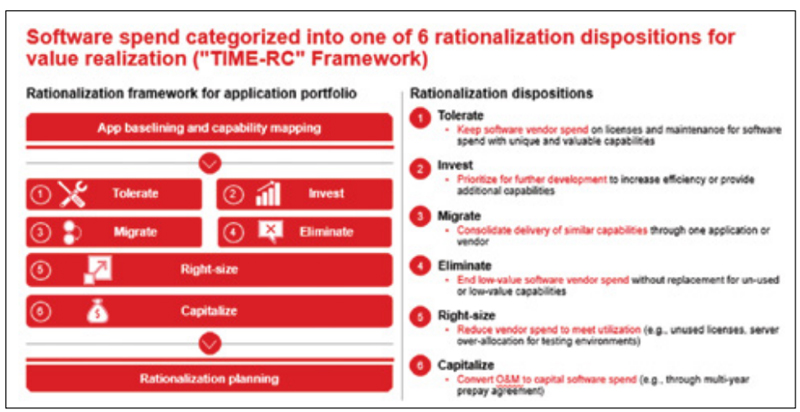
The first step in the application rationalization effort was to establish the framework. This was done in partnership with Boston Consulting Group, wherein we tailored/extended Gartner’s TIME (Tolerate, Invest, Migrate, Eliminate) framework into TIME+RC (Tolerate, Invest, Migrate, Eliminate, Right-size, Capitalize).
As we introduce new technologies and capabilities, we must assess the existing application landscape and decide which systems to retire, replace, or integrate. The goal is always to create a more streamlined, efficient, and agile application portfolio.
1. Process Standardization and Efficiency: Application rationalization directly supported this by eliminating duplicate functionalities, streamlining workflows, and reducing the overhead associated with maintaining a large, complex application landscape.
2. Reducing Tech Debt: By retiring older, less maintainable applications and replacing them with modern, well-architected solutions, they reduced the long-term costs and risks. Capability mapping exercise: applications with duplicative capabilities were eliminated, further reducing tech debt.
3. Improving System Governance: By reducing the number of applications and standardizing on fewer platforms, we are in the process of improving security, compliance, and overall IT governance and control.
4. Data Integration and Interoperability: A smaller number of well-integrated applications makes it far easier to achieve the data sharing and interoperability required for advanced analytics and operational insights.
Balancing Innovation, ROI, and Leadership Growth
Managing a budget of over $280 million across five years for initiatives like Advanced Grid Intelligence and Security (Digital Transformation and Grid Modernization) and Wildfire Mitigation required a highly disciplined and strategic approach to prioritizing investments. The core challenge is always balancing the need for impactful innovation with ensuring tangible returns and maintaining broad stakeholder alignment.
Here’s my approach:
• Strategic Alignment and Visioning with Top-Down Guidance
• Innovation Lens: Within that strategic framework, I prioritize areas where innovation, particularly AI-driven solutions, can create disproportionate value. My work leveraging AI and data & analytics (Technosylva, Gurobi, Fire Potential Index) for active wildfire mitigation is a prime example of an innovative investment prioritized for its immense safety and resilience benefits.
• Value-Stream-Based Prioritization & Business Case Development with Measurable Value (OKRs)
• Continuous Monitoring and Benefit Realization (OKRs)
• Proactive Stakeholder Alignment and Governance
• What advice would you offer to young professionals in your field looking to build successful careers?
Based on my career journey, particularly my focus on strategic transformation, digital innovation, and deep engagement within the utility sector, I’d offer young professionals looking to build successful careers a few pieces of advice.
• Become a Master of Your Domain, and Then Look Beyond It:
• First, dedicate yourself to building deep expertise in your chosen industry. Understand its fundamentals, its challenges, and its regulatory landscape (if applicable). For me, that became the utilities sector.
• Cultivate Exceptional Stakeholder Management and Influence Skills:
• Build relationships and influence outcomes.
• Build consensus and translate complex technical concepts into clear business value.
• Embrace a Strategic & Problem-Solving Mindset:
• Don’t just execute tasks; always understand the ‘why’ behind them and how your work contributes to broader strategic objectives.
• Develop Strong Financial Acumen:
• Be a Lifelong Learner and Adaptable Leader:
• Maintain a relentless curiosity and a commitment to continuous learning. Be open to new methodologies, embrace evolving technologies, and understand that your career will be a journey of constant adaptation. My Advanced Diploma in Innovation from IMD reflects this commitment.
• Finally, seek out opportunities to lead, mentor, and develop talent. A successful career isn’t just about your achievements but about the impact you have on your teams and the organization as a whole.
